
Virginia Family Court Records
Virginia family court records cover a wide range of legal proceedings handled by Circuit Courts and Juvenile and Domestic Relations District Courts across the state. These records include divorce filings, custody orders, child support determinations, paternity judgments, and protective orders. If you need to search for or access family court records in Virginia, the Clerk of Circuit Court in the county or city where the case was filed is the main custodian. This guide explains how to find, request, and understand family court records throughout Virginia.
Virginia Family Court Records Overview
Where to Find Virginia Family Court Records
Virginia uses a two-tier court system for family law matters. The Circuit Court handles divorce cases, property division, spousal support, and adoption proceedings. The Juvenile and Domestic Relations District Court (J&DR Court) handles custody, visitation, child support, paternity, protective orders, and cases involving minors. Both court types keep their own records, and you need to know which court handled your case before you start your search.
The Clerk of Circuit Court in each county or independent city is the custodian of divorce records and related civil files. Under Virginia Code Title 17.1, clerks must keep civil case files open to inspection and provide copies for a reasonable fee. Civil case files must be kept for at least 20 years from the court order date, so older records are still available at most courts.
The Virginia Judicial System maintains directories for all Circuit Courts and J&DR Courts across the state. You can find the address, phone number, and hours for the court in any county or city through these directories. Many courts also participate in the Virginia Court Case Information System (VCCIS), which allows basic case lookups online.
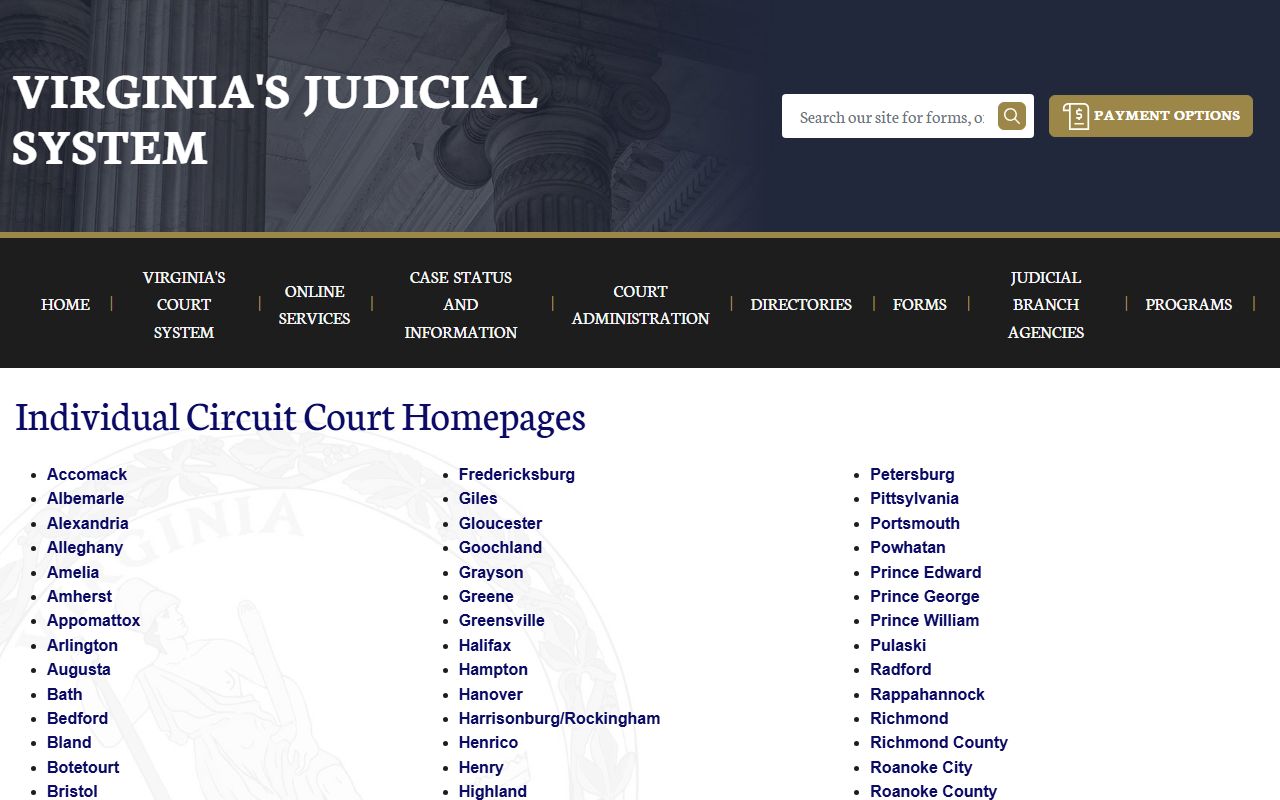
The Virginia Judicial System's Circuit Court directory at vacourts.gov lists every court across the state, making it easy to find the right office for your family court records search.
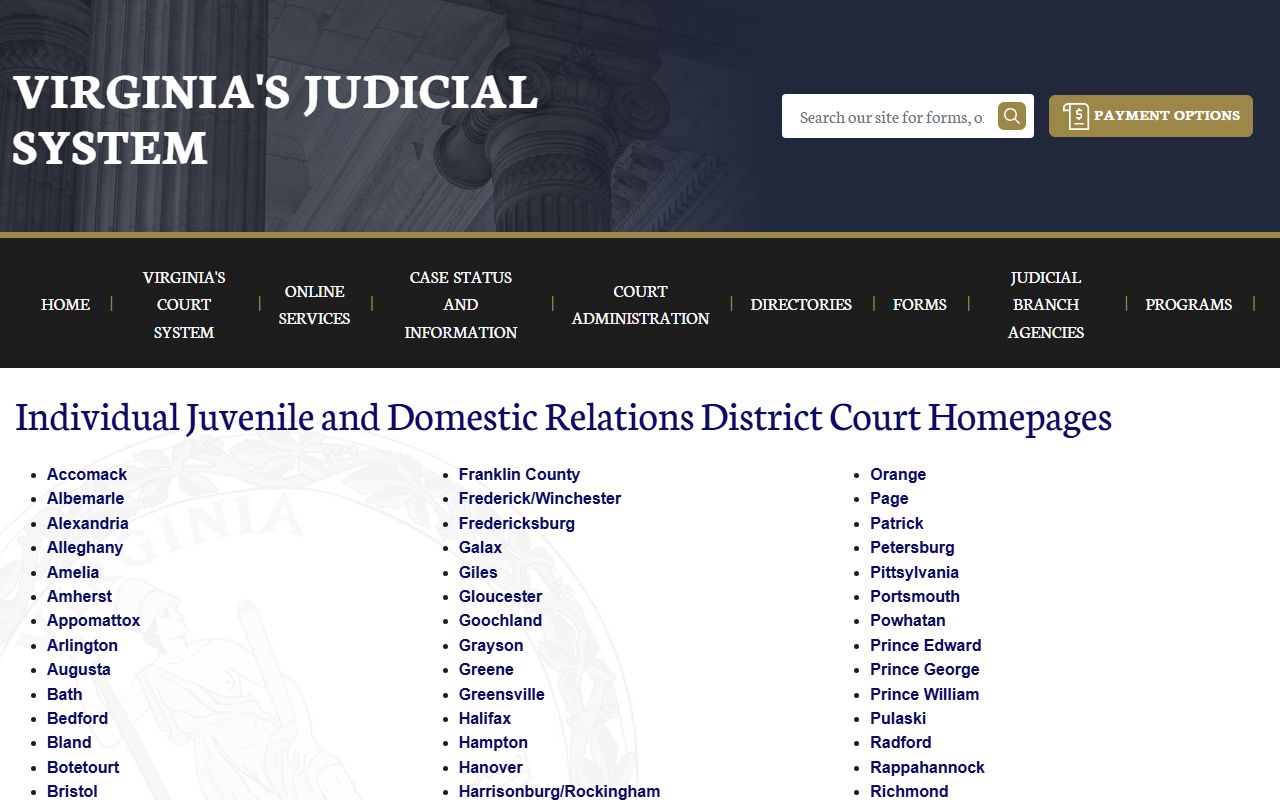
The J&DR Court directory covers all 120 juvenile and domestic relations courts, which handle custody, support, and protective order cases across Virginia.
Note: For divorce records and full case files, go to the Circuit Court Clerk where the case was filed. For custody or support matters, contact the J&DR Court in that jurisdiction.
Circuit Courts and J&DR Courts in Virginia
Virginia's Circuit Courts are courts of general jurisdiction with authority over divorce, property disputes between spouses, spousal support, and contested adoption proceedings. These courts operate under Title 17.1 of the Virginia Code, which covers courts of record, record retention, and clerk duties. Circuit courts also hear appeals from J&DR court decisions, including contested custody and support rulings.
J&DR Courts have exclusive original jurisdiction over matters involving children and families, including custody and visitation disputes, child support establishment and enforcement, paternity determinations, protective orders under family abuse statutes, and juvenile delinquency proceedings. These courts operate under Chapter 11 of Title 16.1. Section 16.1-241 spells out the exclusive original jurisdiction of J&DR courts over cases involving the custody, visitation, support, control, or care of children.
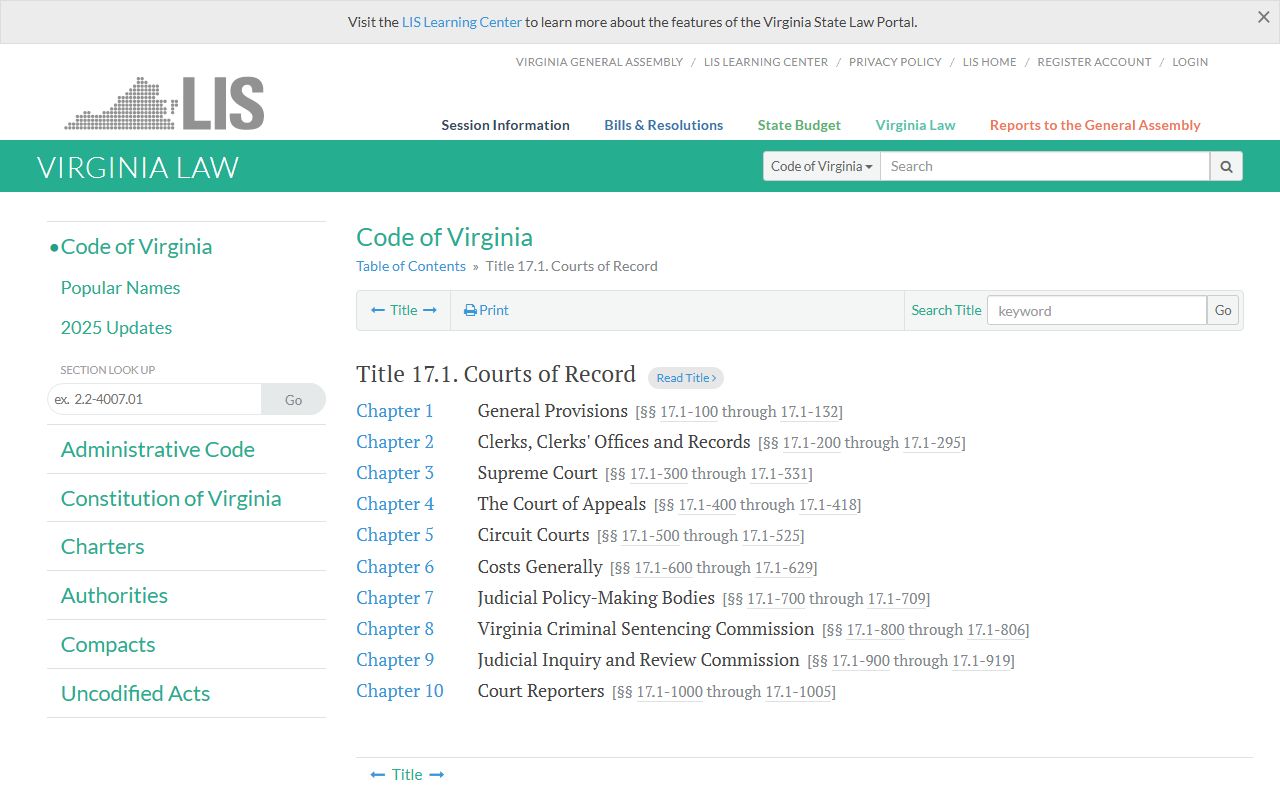
Title 17.1 of the Virginia Code establishes the structure and responsibilities of Virginia's courts of record, including record retention and public access requirements that govern family court files.
Types of Virginia Family Court Records
Family court records in Virginia cover a wide range of documents. The most commonly requested are divorce records, which include the original complaint, any separation agreement, financial statements, and the final decree of divorce. The final decree sets out all the terms: property division, support amounts, and any custody arrangements if the case involved minor children.
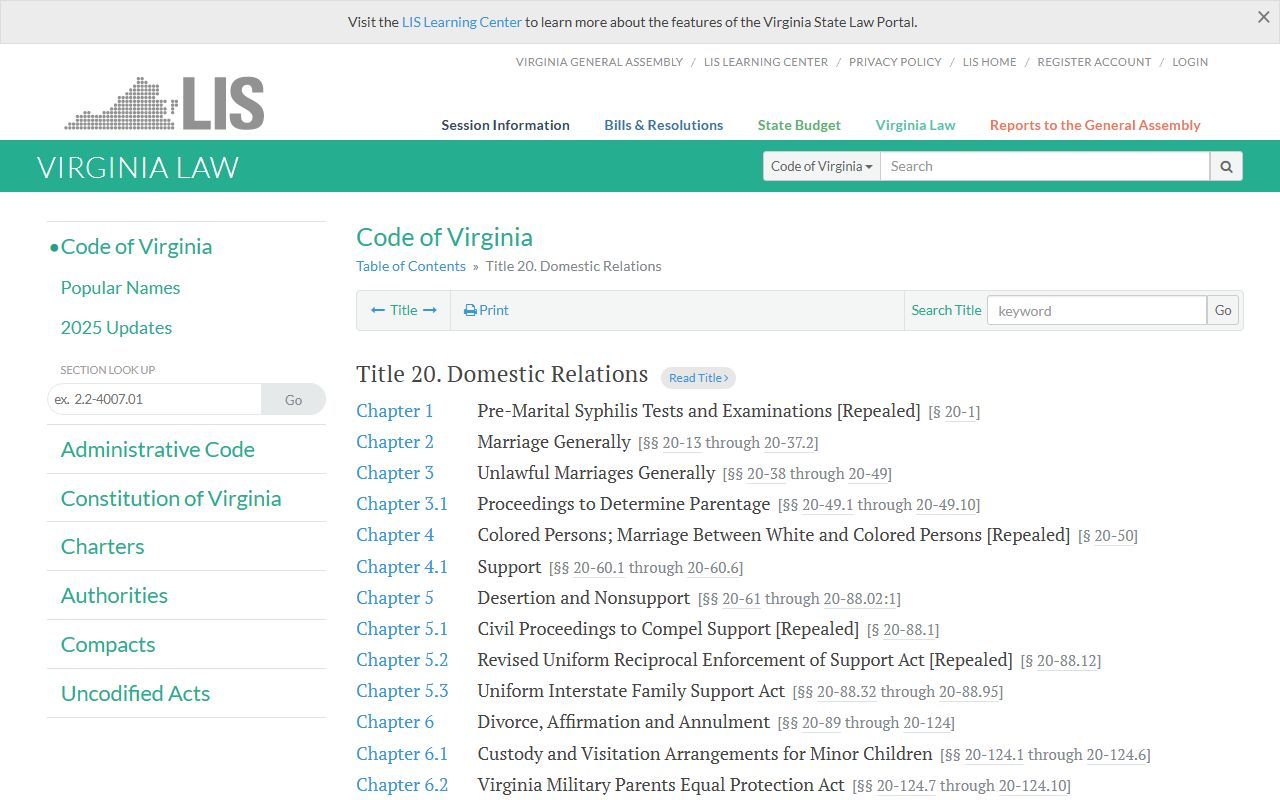
Title 20 of the Virginia Code governs all domestic relations matters in the Commonwealth, from marriage and divorce to custody, support, and paternity, serving as the foundation for family court proceedings.
Custody and visitation records are held at the J&DR Court and may include petitions, hearing notices, court orders specifying custody schedules, and any modifications made over time. Support records include both the original order and any subsequent enforcement or modification actions. Protective order records cover emergency, preliminary, and permanent orders issued under the family abuse statutes.
Marriage records are also maintained by Circuit Court Clerks. Under Chapter 2 of Title 20, marriage licenses are issued by Circuit Court Clerks and must be filed and preserved. Certified copies of marriage records serve as prima facie evidence of the facts stated in them. The clerk keeps an index of all names on file.
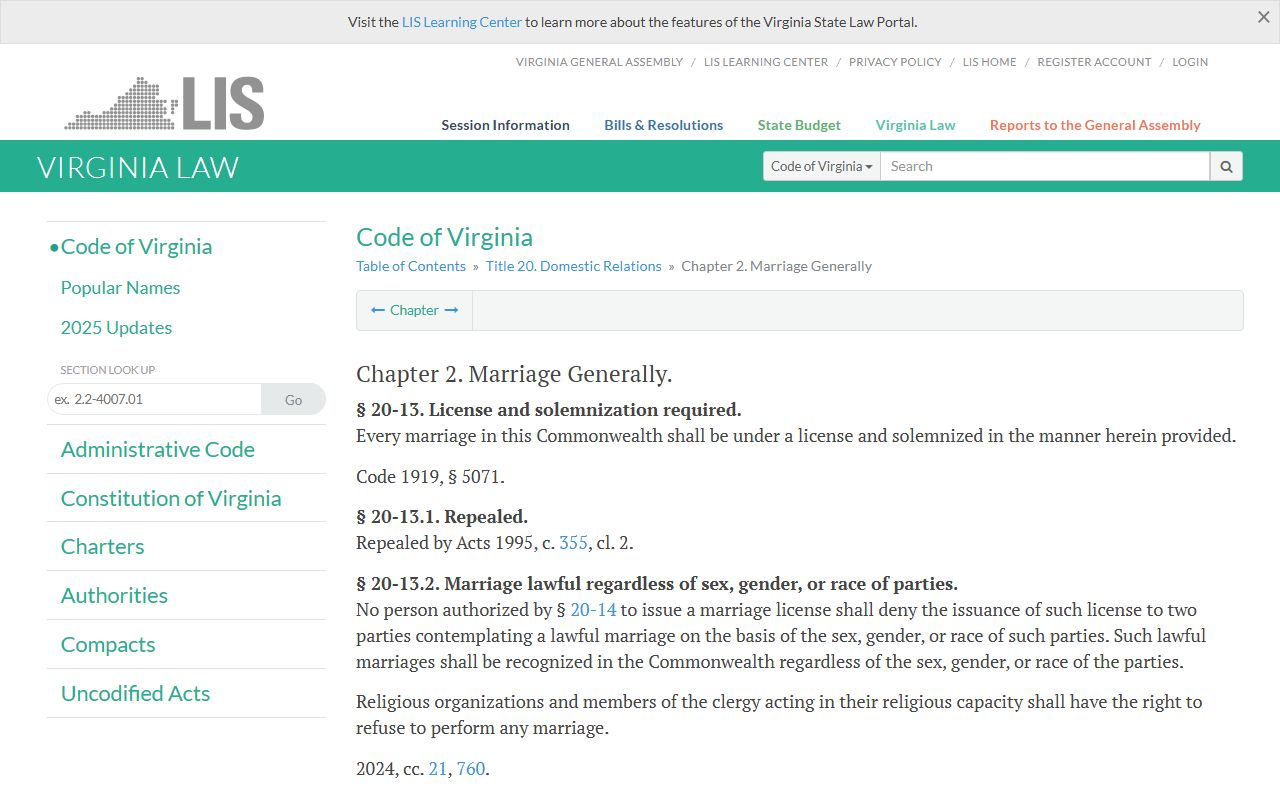
Chapter 2 of Title 20 governs marriage license requirements, recordkeeping by circuit court clerks, and the evidentiary value of certified marriage certificates in Virginia family court proceedings.
How to Search Virginia Family Court Records
You can search for family court records in Virginia online, in person, or by mail. Online searches work best when you need basic case information like case numbers, party names, or hearing dates. Going to the courthouse in person is the most reliable way to view full case files and get certified copies.
The Virginia Court Case Information System (VCCIS) allows public access to case data from participating courts. You can search by name or case number and see basic case status, docket entries, and hearing dates. Not every court participates, and the system does not show full document images for most case types. For the complete file, you go to the clerk's office directly. The Virginia Department of Health's Office of Vital Records maintains a statewide index of divorces and can issue a verification letter, but they do not provide full court documents.
To request records in person, go to the Clerk of Circuit Court in the county or city where the case was filed. Bring the full name of at least one party and an approximate date or year. If you have the case number, the search goes faster. Staff can pull the file and make copies. Plain copies typically cost $0.50 per page. Certified copies cost $2.00 per document plus copy fees. Mail requests are also accepted at most courts. Include the case details, your contact information, a check payable to the Clerk of Circuit Court, and a self-addressed stamped envelope.
Note: Processing times for mail requests vary by court, so call ahead to confirm fees and turnaround time before sending your request.
Virginia Divorce and Family Court Records
Divorce in Virginia is governed by Chapter 6 of Title 20. Section 20-91 sets out the grounds for divorce, which include both no-fault and fault-based options. The no-fault ground requires the parties to live separate and apart without cohabitation for one year. If both parties sign a separation agreement and have no minor children, the separation period drops to six months. Fault grounds include adultery, cruelty, willful desertion, and felony conviction with confinement over one year.
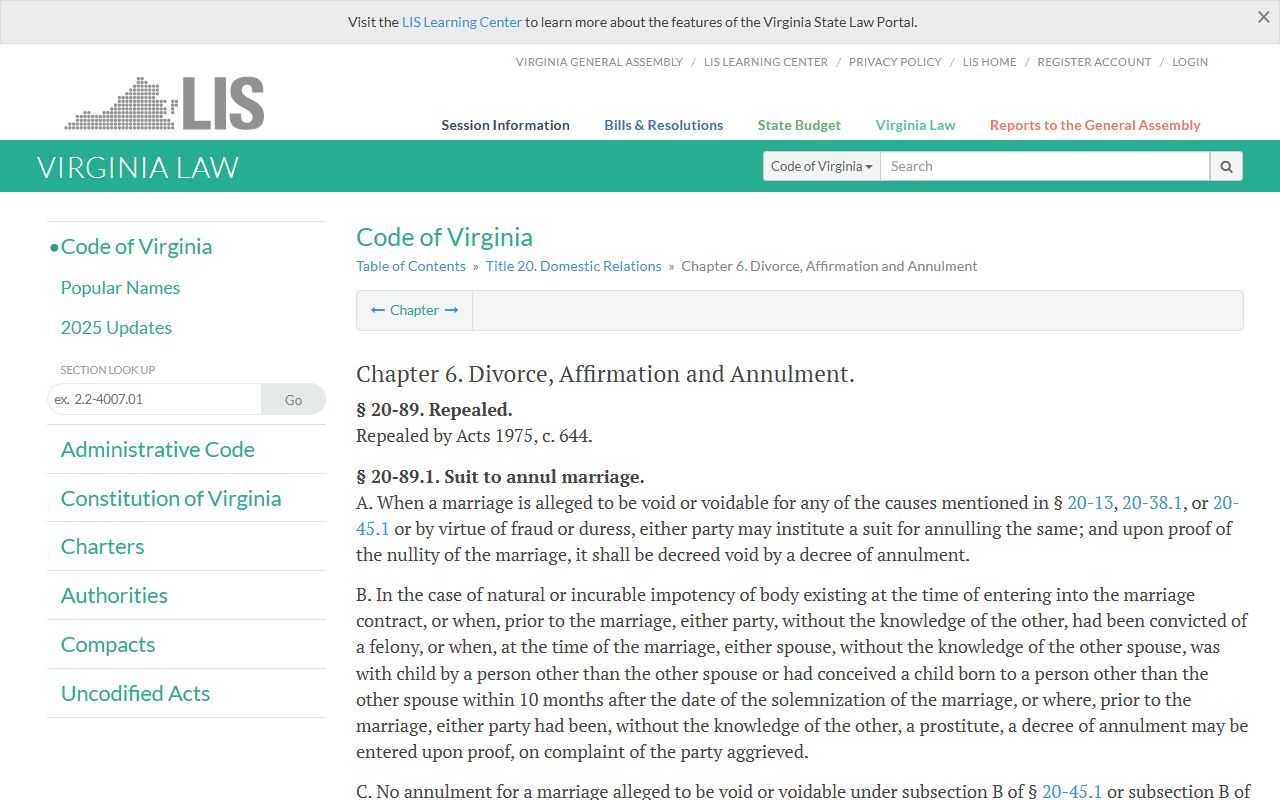
Chapter 6 of Title 20 contains the full statutory framework for divorce, annulment, spousal support, child support, and property division, and is the primary reference for understanding Virginia family court records from divorce proceedings.
Section 20-97 requires at least one spouse to have been a resident of Virginia for six months before filing for divorce. The case must be filed in the circuit court of the county or city where at least one spouse lives. Section 20-107.3 governs equitable distribution of marital property. Virginia is not a community property state. Courts classify property as separate (premarital, gifts, inheritances) or marital (acquired during the marriage) and divide marital assets in a way the court finds just and equitable based on 11 statutory factors. Retirement benefits earned during the marriage count as marital property.
Spousal support decisions follow the 13-factor analysis in Section 20-107.1, which considers each party's obligations and financial resources, the standard of living during the marriage, the duration of the marriage, each party's age and health, and earning capacity. Courts must provide written findings in contested spousal support cases.
Child Custody and Support Records
Custody and visitation proceedings in Virginia are governed by Chapter 6.1 of Title 20. The primary standard is the best interests of the child. Section 20-124.2 states that there shall be no presumption in favor of any form of custody or either parent. Courts look at ten specific factors listed in Section 20-124.3, including the child's age and condition, each parent's relationship with the child, the role each parent played in upbringing, the child's own preference if they are old enough, and any history of family abuse within the past ten years.
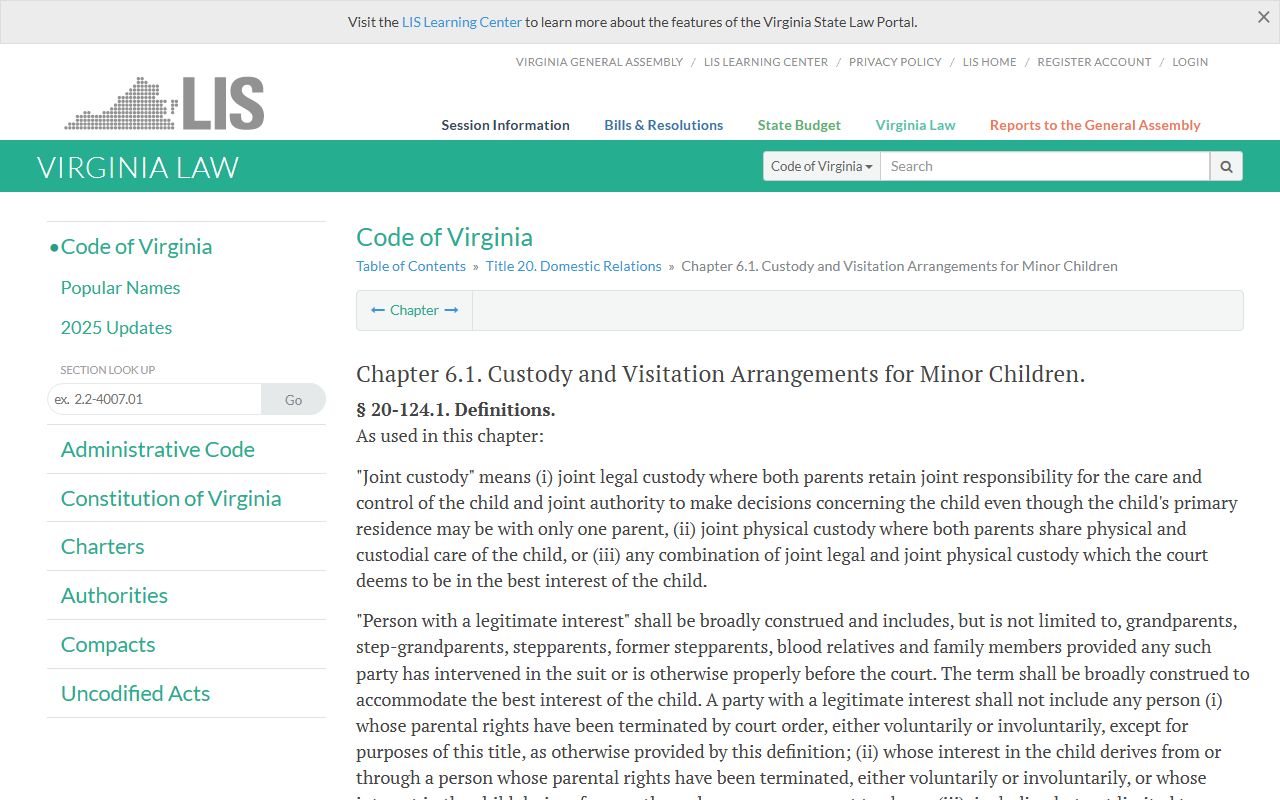
Chapter 6.1 of Title 20 sets the best interests standard and the ten statutory factors courts use in every custody determination, making it the core legal reference for Virginia custody-related family court records.
Child support is calculated under Section 20-108.2 using guidelines that consider both parents' gross incomes, the number of children, health insurance costs, and work-related childcare expenses. Support orders must also address health care coverage. Under Section 20-107.2, support continues for children over 18 who are full-time high school students living with the custodial parent, up to age 19 or graduation, whichever comes first.
Section 20-124.4 requires courts to refer parents in appropriate custody cases to dispute resolution orientation sessions with a certified mediator at no cost. Courts must first ask whether there is any history of family abuse before making such a referral. If a parent plans to relocate with the child, Section 20-124.5 requires 30 days' advance written notice to both the court and the other parent.
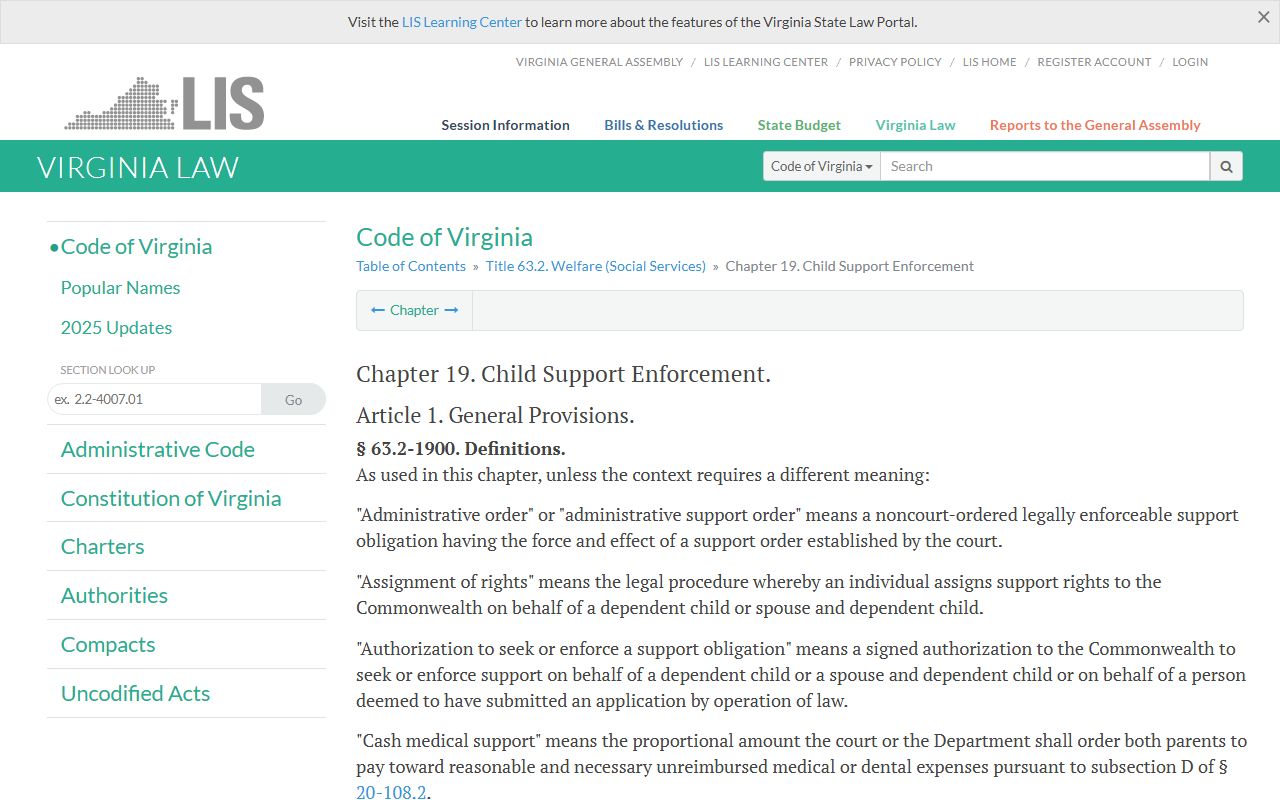
Chapter 19 of Title 63.2 establishes the Division of Child Support Enforcement within the Virginia Department of Social Services, which provides paternity establishment, support order creation, enforcement, and modification services statewide.
The Virginia Division of Child Support Enforcement (DCSE) operates statewide and can help with establishing paternity, getting a support order, and enforcing obligations. DCSE uses tools like income withholding, tax refund interception, license suspension, and property liens to enforce support orders. There is a $1 application fee. Once an order is in place, DCSE can track payments and review orders for modification every three years.
Protective Orders in Virginia Family Courts
Virginia issues three types of protective orders in family abuse cases. Emergency Protective Orders are issued by judges or magistrates and are valid for 72 hours. Preliminary Protective Orders are issued by J&DR judges after notice and are valid for 15 days. Permanent Protective Orders are issued after a full hearing and may last up to two years, with possible extensions.
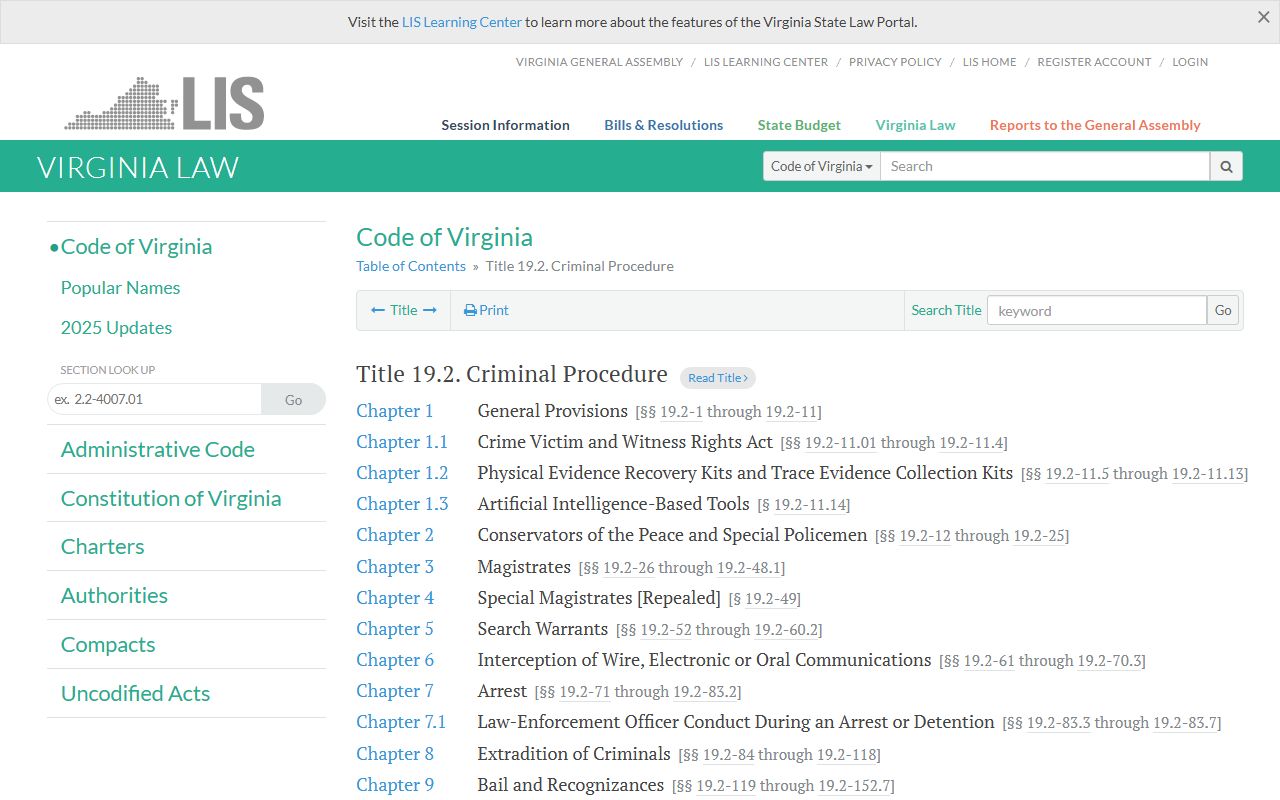
Title 19.2 of the Virginia Code covers criminal procedure and protective orders, including the three-tier system of emergency, preliminary, and permanent orders issued through family court proceedings.
Under Section 16.1-228, "family abuse" means any act of violence, force, or threat that results in bodily injury or places a family or household member in reasonable fear of death, sexual assault, or serious bodily harm. Family or household members include spouses, former spouses, parents, children, people who share children in common, and current or former cohabitants. Section 16.1-253.2 authorizes emergency protective orders in such situations.
Violation of a protective order is a Class 1 misdemeanor. All emergency protective orders are entered into the Virginia Criminal Information Network so law enforcement statewide can see them. Records of protective order proceedings are maintained at the J&DR Court and Circuit Court levels.
Interstate Family Support and Custody
Virginia has adopted the Uniform Interstate Family Support Act (UIFSA) in Chapter 5.3 of Title 20. This law governs cases where parents or children live in different states. Under Section 20-88.35, Virginia courts can exercise personal jurisdiction over a nonresident parent who lived in Virginia with the child, paid prenatal expenses in Virginia, or had sexual intercourse in Virginia that may have resulted in the child's conception.
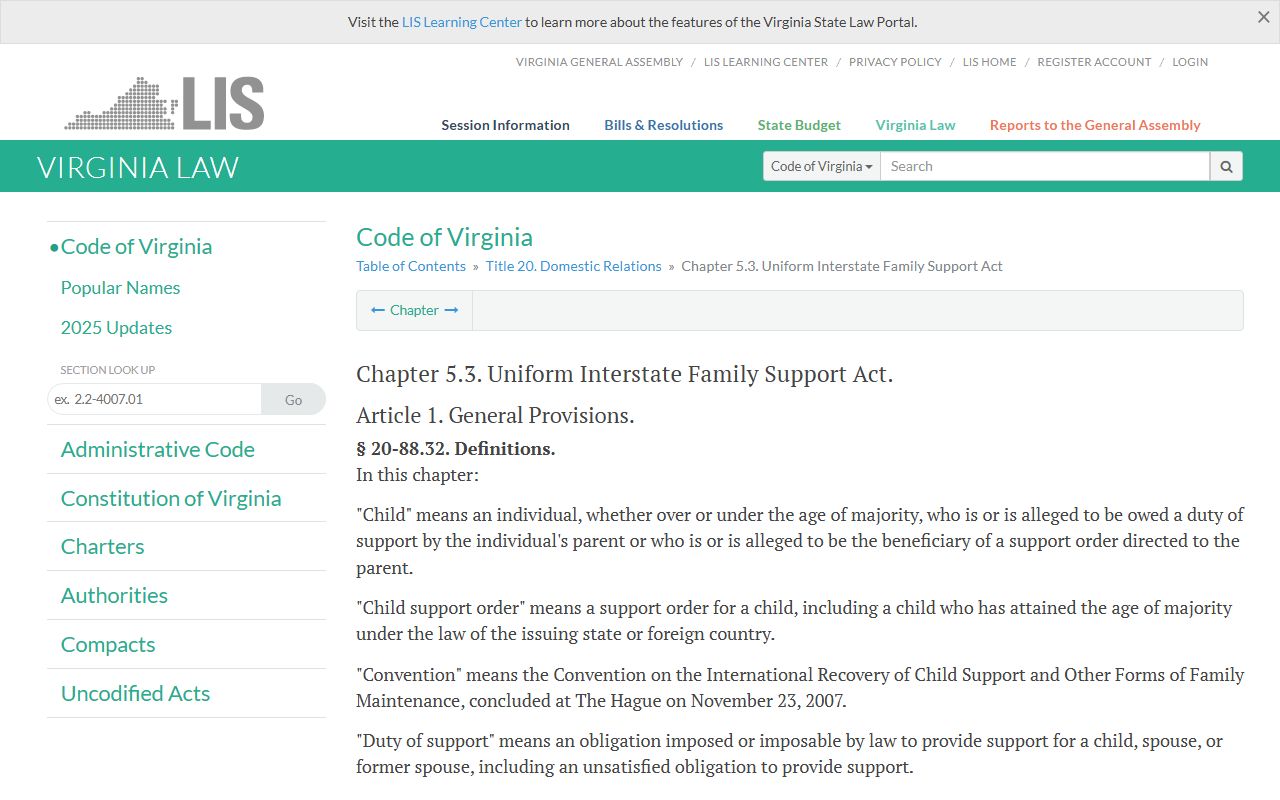
Chapter 5.3 of Title 20 adopts UIFSA in Virginia and provides the framework for establishing, modifying, and enforcing child support orders when parties live in different states.
Support orders from other states can be registered in Virginia under Section 20-88.66 by submitting a letter of transmittal, certified copies of the order, and identifying information about the obligor. Once registered, Virginia courts can enforce the order as if it were their own. Virginia has continuing exclusive jurisdiction over orders it issues as long as Virginia remains the residence of the obligor, obligee, or child.
For interstate custody disputes, Virginia follows the Uniform Child Custody Jurisdiction and Enforcement Act (UCCJEA) under Chapter 7.1 of Title 20. Virginia has jurisdiction if it is the child's home state, defined as the state where the child has lived for at least six consecutive months immediately before the proceeding. Once Virginia issues a custody decree, it retains continuing exclusive jurisdiction until all parties have left the state.
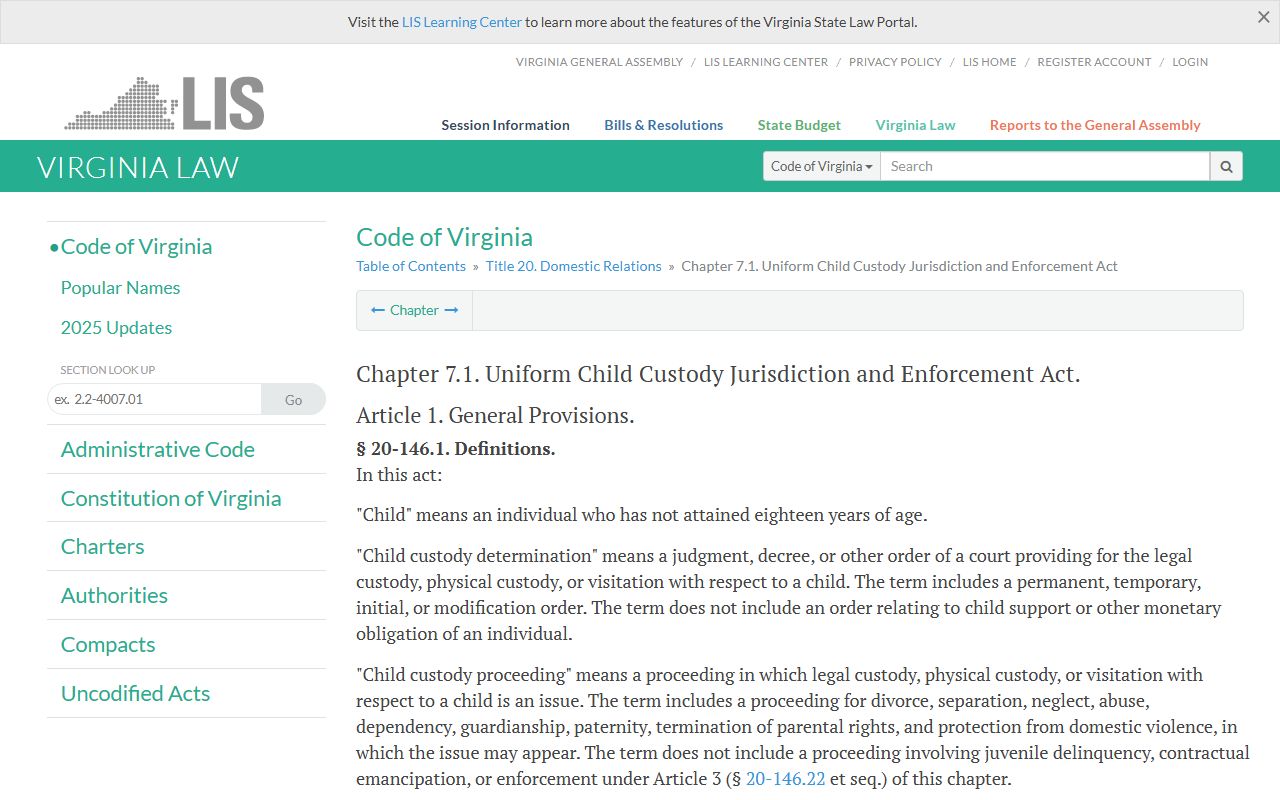
Chapter 7.1 of Title 20 adopts the UCCJEA, which determines which state has jurisdiction over custody cases and governs how out-of-state custody orders are enforced in Virginia courts.
Are Virginia Family Court Records Public?
Most Virginia family court records are open to the public. The Virginia Freedom of Information Act in Chapter 37 of Title 2.2 establishes a strong presumption of public access to government records. Section 2.2-3700 states that government affairs are not intended to be conducted in secrecy and that all public records shall be open unless a specific exemption applies.
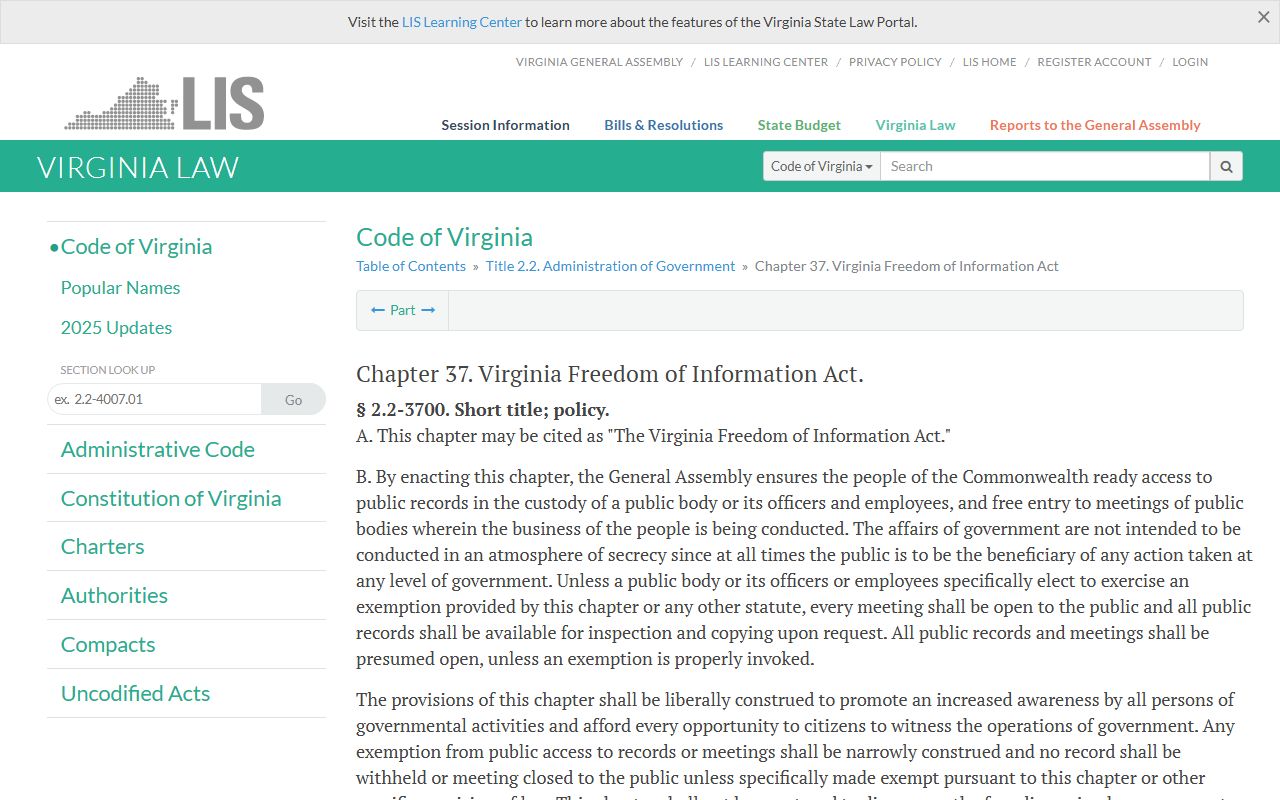
The Virginia FOIA at Title 2.2, Chapter 37 establishes public access rights to court records and sets the procedures for requesting them, including a five-business-day response requirement.
Court records maintained by clerks are subject to specific provisions in Sections 16.1-69.54:1 and 17.1-208, rather than general FOIA provisions. Section 17.1-208 establishes that records held by clerks shall be open to inspection and that copies must be provided for a reasonable fee. Under Section 17.1-208(F), any objection or claim of confidentiality must be raised within 30 days.
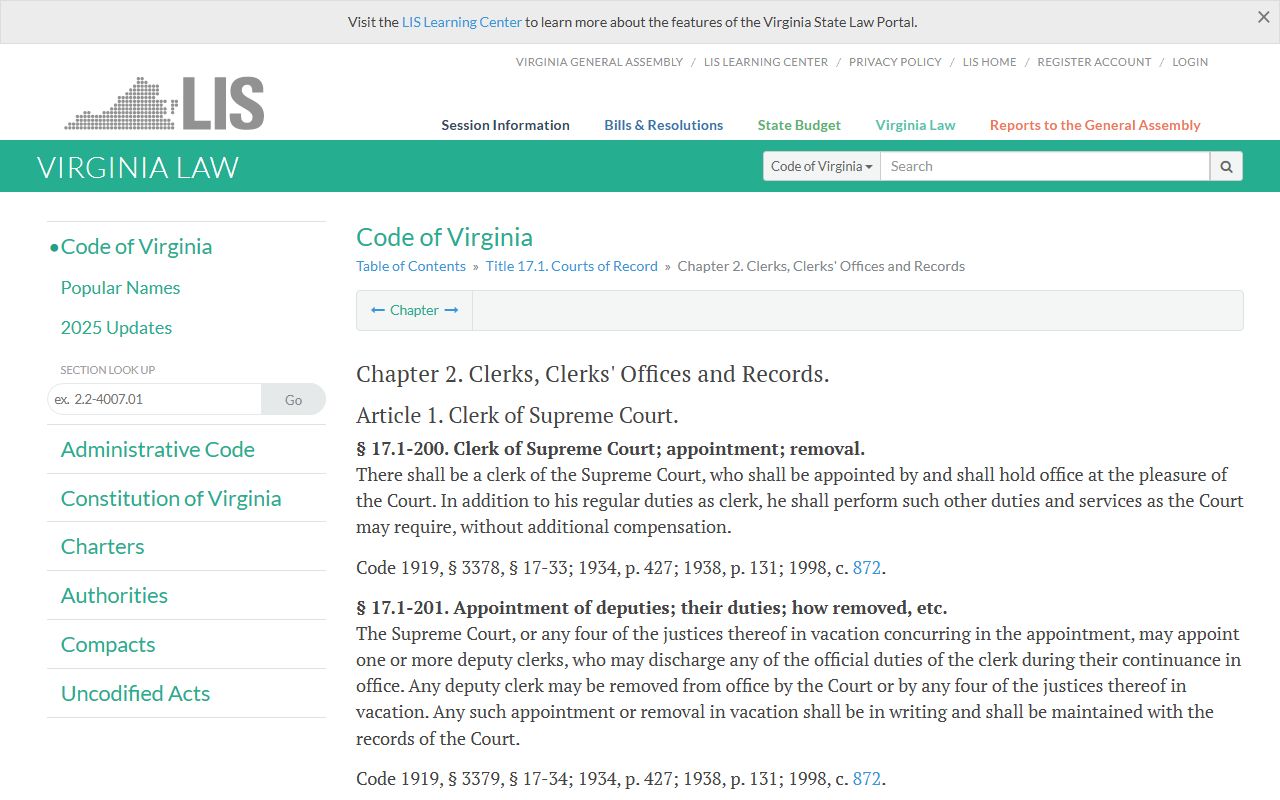
Chapter 2 of Title 17.1 governs Virginia court clerks and sets out record retention schedules, public access rules, and copy fee limits that apply to all family court records statewide.
Some records carry confidentiality protections. Juvenile records have strong restrictions under Title 16.1. Financial source documents like tax returns may be sealed. Protective order details and custody evaluation reports are often restricted. Social Security numbers and account numbers are redacted from public filings under standard court rules. If you are a party to a case, you generally have broader access than a member of the general public.
Example: Loudoun County Family Court Records
Loudoun County offers a good example of how family court records work at the local level. The Loudoun County Circuit Court is located at 18 East Market Street in Leesburg. The phone number is 703-777-0270, and the office is open Monday through Friday from 8:00 AM to 4:00 PM. Effective April 1, 2024, the court adopted new local rules and procedures under the 20th Judicial Circuit.
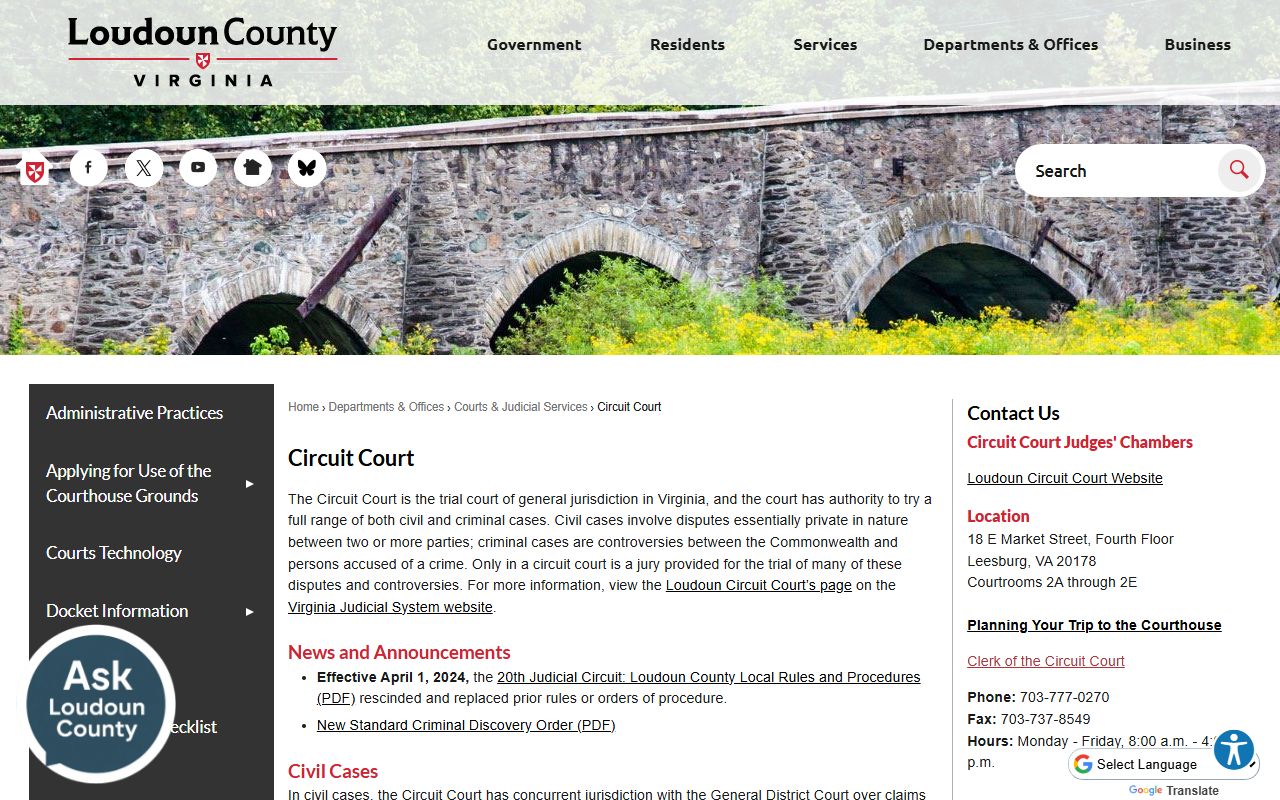
The Loudoun County Circuit Court at loudoun.gov/circuitcourt provides local rules, forms, and contact information for family court record requests in Leesburg, Virginia.
Loudoun County divorce case files contain the original Complaint for Divorce, service of process documentation, civil cover sheet, pendente lite motions and orders, financial statements, any property settlement agreement, child custody evaluation reports, and the Final Decree of Divorce. Copies cost $0.50 per page, and certified copies cost $2.00 per document plus copy fees. The court also accepts mail requests.
The J&DR Court for Loudoun County is located at 20 East Market Street in Leesburg, phone 703-777-0303. The Loudoun County Child Support Services office is at 102 Heritage Way NE in Leesburg, reachable at 703-777-0253. Marriage license records in Loudoun County date back to 1757.
Virginia Family Court Records by Location
Virginia has 95 counties and 39 independent cities. Each has its own Circuit Court and J&DR Court. Select a county below to find court contact information and resources for family court records in that area.
Browse Virginia Counties
Each Virginia county has a Circuit Court Clerk who maintains divorce records and a J&DR Court that handles custody and support cases. Pick a county to get started.
Virginia Family Court Records in Major Cities
Virginia's independent cities each have their own Circuit Court and J&DR Court. Select a city below to find the right court and resources for family court records in that location.